
How Santa Cruz County Residents Surface
What are you actually testing? That question shapes every Santa Cruz County residents directory search. An APN or street address points to the Assessor and GIS. A person's name points to the Recorder's party index. It can also lead to Superior Court case lookup, County Clerk filings, or a historical directory. A known event points to a vital-record application or a probate file. Each result is evidence about one record. It is not a master list of everyone at a place.
Ownership, registration, and historical presence are different claims. An assessed owner may get mail elsewhere. A court party may have lived in another county. A directory subscriber may have shared a home with people the volume left out. So start narrow. Keep the record number and date, and label each result by what it truly proves.
- Use the Assessor Parcel Lookup or GISWeb to turn an address into an APN and jurisdiction.
- Use the Recorder index for principal parties, deeds, liens, and document numbers.
- Use California My Voter Status only for a personal registration check; the county voter file requires a qualifying purpose and identification.
- Use court, vital, business, license, newspaper, and directory sources for a named event or historical link.
- When the web trail ends, ask the custodian for a focused copy, counter search, mail request, library lookup, or CPRA record request.
Santa Cruz County Records Desk
The offices behind the Santa Cruz County residents directory split the labor. The Assessor identifies parcels and keeps the assessment roll. The Recorder indexes instruments that transfer or encumber land. Elections holds a confidential voter file. The Superior Court keeps public case information, while the Recorder and CDPH handle different parts of vital-record service. The Clerk of the Board routes county record requests when an identifiable record is not already posted.
These offices sit close together in the Santa Cruz Government Center, but their records never merge. A deed proves a transfer. A parcel card links an APN to an owner or mailing line. Neither is a household list.
Santa Cruz County Recorder
701 Ocean St., Room 230
Santa Cruz, CA 95060
831-454-2800
Santa Cruz County Elections
701 Ocean St., Room 310
Santa Cruz, CA 95060
831-454-2060
Santa Cruz Recorder's Online Cutoff
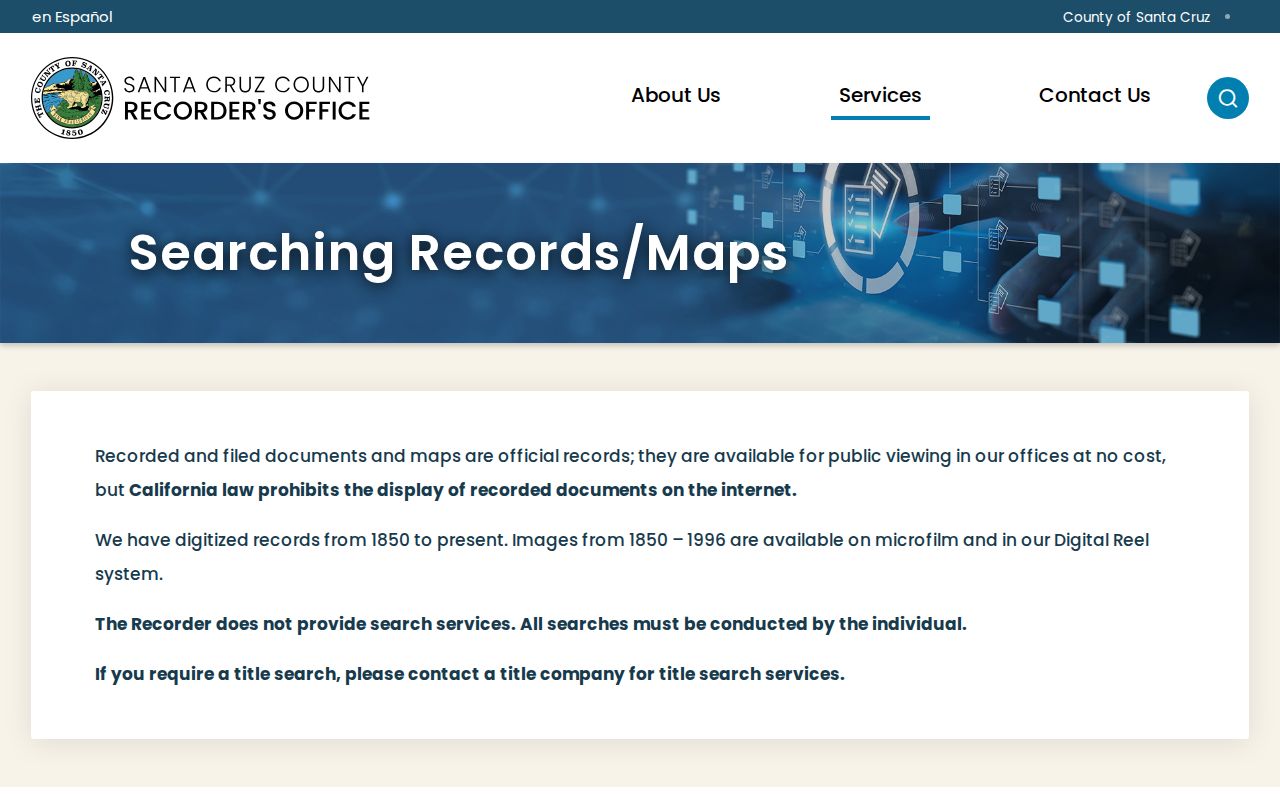
The Santa Cruz County Recorder supplies one of the clearest local time breaks. The free online Index of Official Records starts in 1978. The office reports digitized records from 1850 to the present. Images from 1850 through 1996 sit on Digital Reel and microfilm. Anything before 1974 sits in handwritten volumes at the Santa Cruz office. A failed web search is a routing problem. It is not proof that a deed or lien fails to exist.
The party-name system has quirks of its own. From 1974 through 1990, first words and other terms were abbreviated. Later terms stayed shortened after 1990. Since 2010, every word is indexed as written. The office provides a party list for variants. Search a person, trust, or older institutional party across date bands and spelling forms. Compare the legal description before treating two hits as one chain.
At the counter, viewing is free. Copy requests need a document number, recording year, at least one party name, and document type. Copies run $1 per page, with certification at $3 per document. Filed maps follow a separate route. Supply the map book and page, and expect $5 for the first page plus $2 for each added page. Kiosks remain at Room 230 and at 500 Westridge Drive in the South County office.
Buying copies online requires an account with contact and mailing details. California limits what recorded information can appear on the open web. Government Code section 7928.205 removed many filed-map links after January 1, 2025. The counter can show more than the screen does.
Santa Cruz County Parcel Search
The Assessor and GIS form the address side of a Santa Cruz County residents directory. The County Assessor's Parcel Lookup accepts an address or an APN. GISWeb places the parcel on a map and helps confirm neighboring polygons, districts, and jurisdiction. The APN stays the stable bridge to the Recorder even when a street label changes.
Read the fields in the order the record trail needs. A situs address is the physical parcel location. An owner mailing address is where tax and assessment mail goes. The two can differ by county, state, trust, manager, or post-office box. The parcel card may show assessed land and improvement values, property traits, exemptions, and an assessment-roll owner or mailing line where display is permitted. It does not enumerate every household.
| Portal field | What it does in the lookup |
|---|---|
| APN / Parcel Number | Uses the county parcel identifier as the most stable search key. |
| Address | Finds the situs or property address; copy the number and street as shown. |
| Owner name | Availability varies online; verify the current public search policy before relying on it. |
| Search / Submit | Returns a matching parcel or account when a search key is accepted. |
| Reset / New Search | Clears the prior query before another parcel is tested. |
- Roll
- The Assessor’s list of taxable parcels and assessment information.
- Index
- A finding aid with names, dates, types, and record locators, not always the full image.
- Parcel
- A mapped unit of land identified by an APN and tied to a legal description.
- Criss-cross directory
- A reverse directory arranged by address or phone so a place can lead to a listed subscriber.
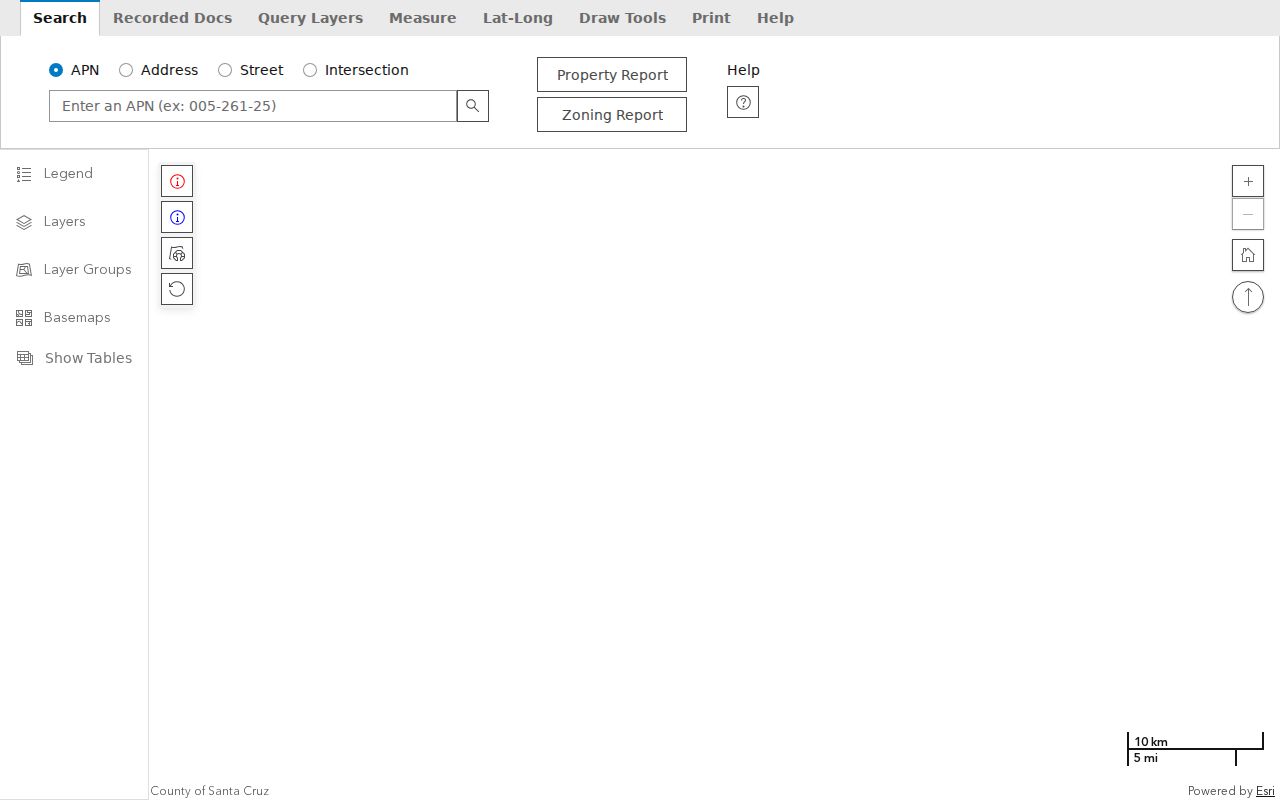
The County GIS page is a map tool, not a people list. Use it to confirm the parcel. Then cross into the Assessor or Recorder record that backs the claim. The Santa Cruz County GISWeb page displays the map route for locating a parcel. It also shows nearby shapes. It serves the geography step. It is no substitute for a boundary survey.
Save the APN once you have it. That single number can anchor an assessor result, a deed chain, a permit question, and a later historical comparison.
Current Santa Cruz County Directories
Current Santa Cruz County sources each answer one slice of the residency question. Match the record to the claim. An assessor parcel shows an assessed owner. A court docket shows a case party. A business filing names an officer or agent, while a library collection can place a person in an earlier year of a city directory. Flattening them into one list of everyone at an address misstates what each record proves.
| Source | People or places shown | Keeper | Access |
|---|---|---|---|
| Parcel lookup | APN, situs, assessed owner and property facts | County Assessor | Free address/APN route |
| Official-record index | Parties to deeds, liens, maps, and related instruments | County Recorder | Free index; copies follow office rules |
| Public case lookup | Parties, case type, filing events, and status where public | Superior Court | Online discovery plus clerk access |
| FBN and business filings | Trade-name registrants, entities, agents, and officers where filed | County Clerk and Secretary of State | Free search; copy rules vary |
| Historical collections | Occupants, subscribers, relatives, and local events by year | SCPL, MAH, UCSC | Library, archive, microfilm, or digital access |
Keep the source label attached to any name you find. Assessed owner, case party, FBN registrant, licensed person, or directory subscriber each carry different weight. When the question shifts from a place to one person, a Santa Cruz County resident lookup fits better than a street directory sweep.
Santa Cruz County Court and Vital Trails
A court case or a vital certificate is proof of an event. It is not a directory entry. Through Santa Cruz Superior Court's public case tools, a case number can surface a caption, party roles, case type, the filing date, hearings, docket events, and a disposition. That holds so far as the category is public remotely. The register of actions is not the whole file. Family, juvenile, sealed, adoption, and protective-order matters stay restricted. The same goes for identifier details. Any precise document request begins with a case number and the right division.
Vital records run through a separate gate. Birth, death, and public-marriage certificates for Santa Cruz County come from the County Recorder. CDPH serves as the statewide alternative and handles amendments. Confidential marriage certificates never leave the issuing county clerk. They reach only a spouse or a court order. An informational copy works for establishing a historical event. But it is marked so it cannot establish identity.
The Santa Cruz County vital-record application page shows the county route for birth, death, and marriage requests. Treat it as a request for a controlled certificate rather than a public name directory.
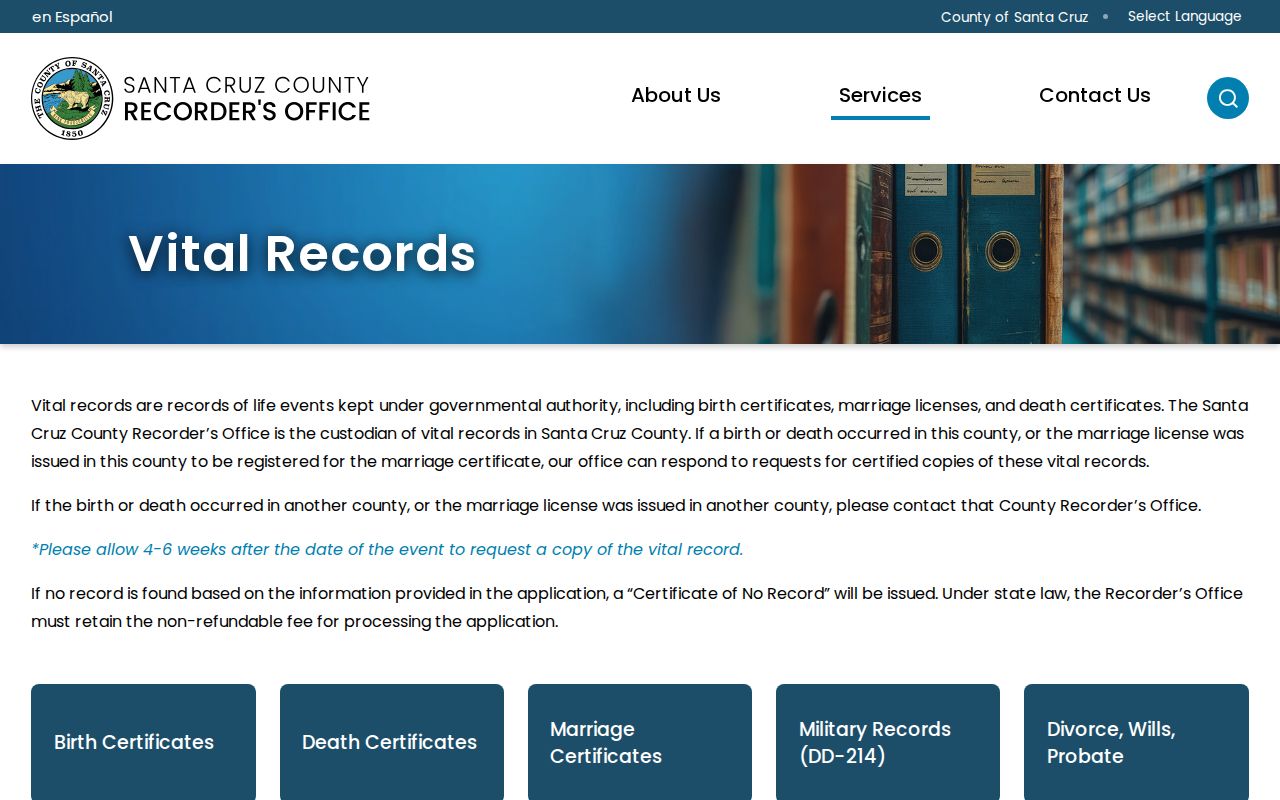
Keep the event date, the place, the record type, and the copy category separate. A hit in a historical index does not loosen the eligibility rules for a certified copy.
| Record clue | Careful statement |
|---|---|
| Probate case | May identify a decedent, petitioner, heirs, and filings when the public file permits access. |
| Death certificate | Confirms a death event subject to copy eligibility; it is not a live residence record. |
| Marriage certificate | Connects parties to a public marriage event; confidential marriages follow stricter access rules. |
| Divorce case | Shows a proceeding and case trail; a CDPH Certificate of Record for 1962 through June 1984 is not the decree. |
Santa Cruz County Voter File Gate
California My Voter Status works as a personal self-check. Supply your own identifying details. It will confirm registration status, party preference, polling place, vote-by-mail status, or ballot status. It will not take a neighbor's address and hand back a household. Santa Cruz County Elections keeps the voter file confidential. Elections Code sections 2188 and 2194 govern that confidentiality.
Getting the county file takes a qualifying purpose. Election, scholarly, journalistic, political, or governmental use qualifies. Photo identification, a certification, and advance payment are also required. Published products include walking lists, printed indexes, and a CD list. Sorting by street or alphabetically may be possible. But ballot contents stay secret. Participation history never shows a vote choice.
The California My Voter Status page illustrates that personal lookup boundary. In a Santa Cruz County residents directory it fits only as a self-check. It also serves as a reminder that the controlled county file moves through a separate channel.
Santa Cruz Elections sits in Room 310 at 701 Ocean Street, reachable at 831-454-2060, with weekday service from 8 a.m. to 5 p.m. Written requests and the current application govern the accepted route for file access.
Use the right voter path. A personal status check is not permission to investigate another person. The county file is released only through the statutory purpose, identification, certification, and fee process.
Santa Cruz County Business Affiliations
Business and license records help separate two people who share a name. The County Clerk's FBN index works well for a sole proprietor or local trade name. The Secretary of State's bizfile search returns entity status, formation details, and addresses. It also lists agent information and filed officer or manager names where present. Those fields establish an organizational connection, not a personal home.
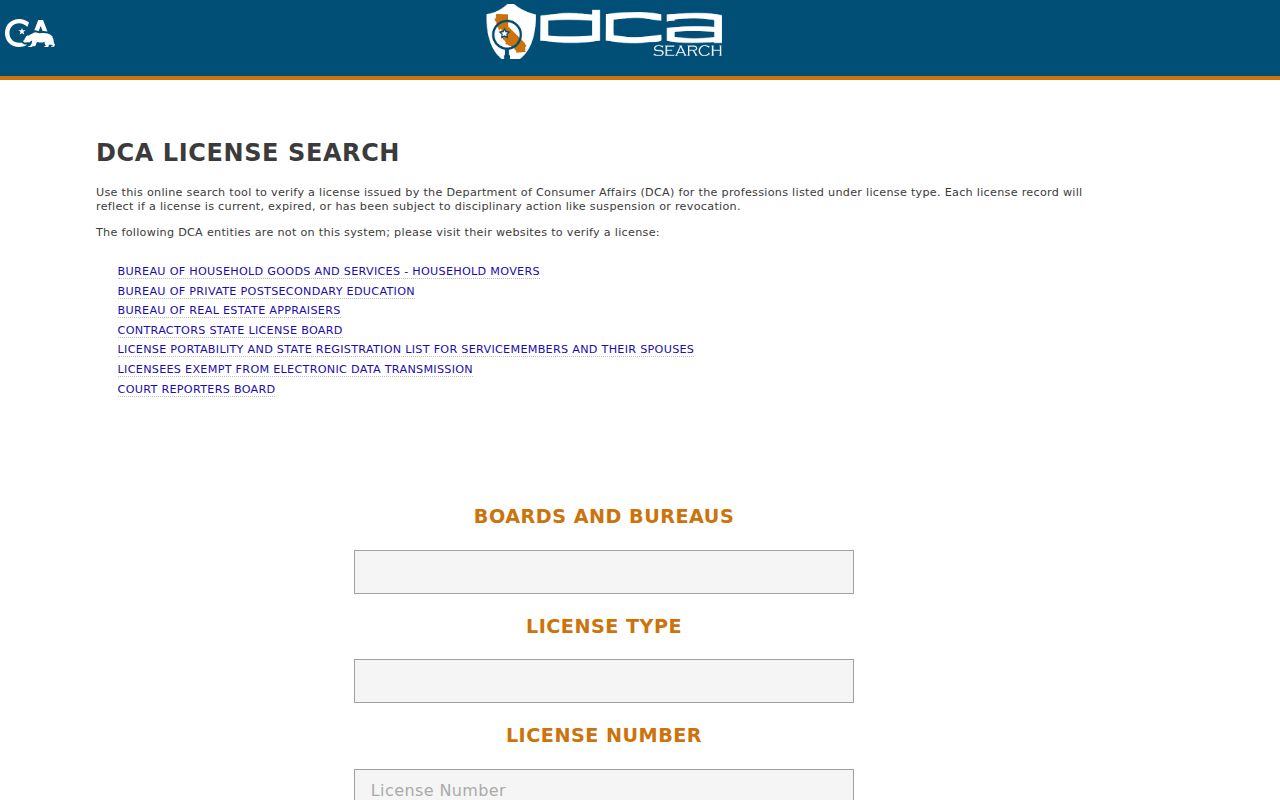
California Department of Consumer Affairs searches add license type, number, status, dates, and discipline links. The State Bar, CSLB, Medical Board, ABC, and other boards run separate portals. Always match a name to a filing date, entity number, professional identifier, or business address. Only then merge it with a county record.
The California business search page shows the state entity route. It is used for a name or file-number check.
The California license search page shows the board and license fields. These narrow a professional record. It never claims where the person lives.
FBN filings can be searched online, at 701 Ocean Street, Room 310, or by email. Mail works too, under the County Clerk's instructions. A broad result set stops at the first 160 matches. Use a formatted FBN number instead. A narrow registrant name is the better key.
The California license search page lets a Santa Cruz County researcher narrow a professional record by board and license fields. It confirms a credential. It does not claim where the person lives.
FBN filings can be searched online, at 701 Ocean Street, Room 310, by email, or by mail under the County Clerk's instructions. A broad result set stops at the first 160 matches. Use a formatted FBN number instead. A narrow registrant name is the better key.
Old Santa Cruz County Address Trails
An old address earns its keep. Turn it into an APN, a legal description, and a jurisdiction. The current parcel points to the latest deed. That deed names a seller, and the seller becomes your next grantee search. Historical directories, census schedules, newspapers, permits, and maps then fill in the people. They cover the years between ownership transfers.
Mailing geography in Santa Cruz County sets a real trap. A Santa Cruz mailing line can sit inside the city or out in unincorporated land. Watsonville postal addresses stretch into the Pajaro Valley. A 95033 envelope may say Los Gatos. Meanwhile the parcel sits in northern Santa Cruz County. Check GIS before picking a permit or planning custodian.
Ownership is not a household roll, either. One multi-unit parcel can carry a single assessed owner and many households. A mailing address may reach an owner who lives somewhere else entirely. A criss-cross entry names a subscriber for one year and skips the rest. For a current chain of addresses, the Santa Cruz County street directory keeps those parcel records inside one workflow.
California Requests for Santa Cruz Records
The California Public Records Act, Government Code sections 7920.000 through 7931.000, is the fallback. It covers an identifiable, non-exempt record held by a state or local agency. A request needs no magic words and no stated purpose. It should simply name the office, subject, place, date range, and format. CPRA obliges an agency to locate existing records. It cannot make the agency build a residents directory or answer an open research question.
Section 7922.535 sets the usual determination window at 10 days. A written extension of up to 14 days is allowed for defined unusual circumstances. Inspection is generally free. Copy charges stay limited to direct duplication cost unless another statute sets a fee. Redactions, privacy rules, juvenile files, protected addresses, and law-enforcement exemptions can narrow what gets released.
The Santa Cruz County public-record request route is the right starting point. Use it when a known county record is not already online. Describe the record you want. Don't ask an office to find "everyone" at an address.
Keep a short trail for any request. Note the custodian, date sent, exact record description, response date, withheld section, and copy format. If the source is a deed, court file, vital certificate, or voter record with its own access rules, use that dedicated procedure first.
Historical Santa Cruz County Directories
Santa Cruz Public Libraries hold most Polk Santa Cruz directories from 1910 through 1988, plus some Haines criss-cross volumes from 1977 through 2015. The earlier shelves go deep. A 1902 Santa Cruz City Directory, McKenney's 1879 District Directory, and Coast County Directory volumes from 1884 to 1885 all sit there, alongside regional San Jose titles and business directories from the 1870s and 1880s. Two more institutions widen the net. The Santa Cruz Museum of Art & History and UCSC hold overlapping print, manuscript, map, and photographic material. The SCPL local-history resources page maps the library route through directories, newspapers, cemetery material, yearbooks, and archives. Any serious residents directory search in Santa Cruz County should start on those shelves.
Alphabetical volumes suit a search that starts with a person. A street section or a Haines reverse volume lets you start with an address instead. Every entry is selective, though. Occupations, spouses, boarders, subscribers, and rural households may be recorded unevenly. Ownership and occupancy are separate questions. Because of that, the Recorder search pairs well with the historical shelf when you trace past residents of a Santa Cruz County property.
A fuller method lives in the Santa Cruz County Directory Book. The home-level rule stays simple. Copy the name and address exactly, save the publication year, and verify the claim against a second source before trusting any residents directory entry.
Santa Cruz County Family Research Paths
Some of the best resident searches are human ones. A probate file can help locate heirs. A yearbook or campus archive can reconnect old classmates. Confidential adoption questions belong with the official adoption services, which are the lawful route. A newspaper obituary can hand you a date, a relative, or a former address. That detail can then steer a recorder, court, or library search.
Four institutions split the county's memory. Santa Cruz Public Libraries, UCSC Special Collections, the Museum of Art & History, and Pajaro Valley Historical Association each serve a different corner. When a north-county search misses a family, farm, school, or local paper, the Watsonville and Pajaro Valley material matters. Search compound names, accents, initials, married names, and period place labels. Never guess a person's identity from a surname alone.
Unclaimed-property records can yield a name and a reported-address lead. The state's result is not proof of where anyone lives now. A claim demands identity and entitlement evidence. A professional license or business filing works the same way. It is an affiliation trail, not a residence certificate.
When Santa Cruz County Web Searches Stop
Online tools are finding aids, not the whole records office. The counter, mail, phone, library, archive, and request channel still count. The Recorder maintains counter indexes, kiosks, Digital Reel, microfilm, mail copy requests, and map requests. The court offers public terminals and division clerks. Vital-record offices accept in-person and mail applications. SCPL supplies print, microfilm, staff help, and local-history collections.
Weigh the official route against any commercial compilation before you accept a lead. A custodian record has a defined keeper. It also carries a record number, an event date, and an access rule. A commercial result may merge names, lose context, or lag behind a correction. Treat the category as a lead only. Then go back to the office that created the record.
| Route | Strongest use | Main caution |
|---|---|---|
| Official county or state record | Verify a defined event, parcel, filing, or case | Access limits, fees, redactions, and coverage gaps apply |
| Library or archive collection | Place a person or household in a past year | Publication bias and missing years can distort absence |
| Commercial compilation | Generate a possible spelling or source lead | Stale, merged, incomplete, and not a custodian record |
Lawful personal use. Public records support family history, civic research, title questions, and personal safety. Do not use a Santa Cruz County record to stalk, harass, threaten, or repeatedly contact a person who has asked for no contact.
Santa Cruz County Record Geography
Santa Cruz County took shape in 1850 and briefly answered to the Branciforte name. Old catalogs may file records under either term. Geography matters here. Santa Cruz, Watsonville, Capitola, and Scotts Valley each generated their own paperwork. Large unincorporated stretches answered only to the county. One address can sit in a postal community, a census place, a city limit, and a county jurisdiction at once.
Names changed with the paperwork too. Mission and church registers, Mexican land-grant papers, post-statehood county books, directories, newspapers, maps, and census schedules all kept their own habits. An older street directory might list a wife through her husband, skip a rural laborer entirely, or credit a subscriber rather than the whole household.
Recent programs add another wrinkle for anyone dating a record. Santa Cruz County rolled out its free Fraud Notify service in October 2025. California's DROP platform started a single-request data-broker deletion process in 2026. Neither alters what a government record is. Both simply make it easier to tell the difference between monitoring, a privacy step, and actual verification of a document.